Portugal House Flipping 2026: Costs, Taxes, ROI, and the 70% Rule
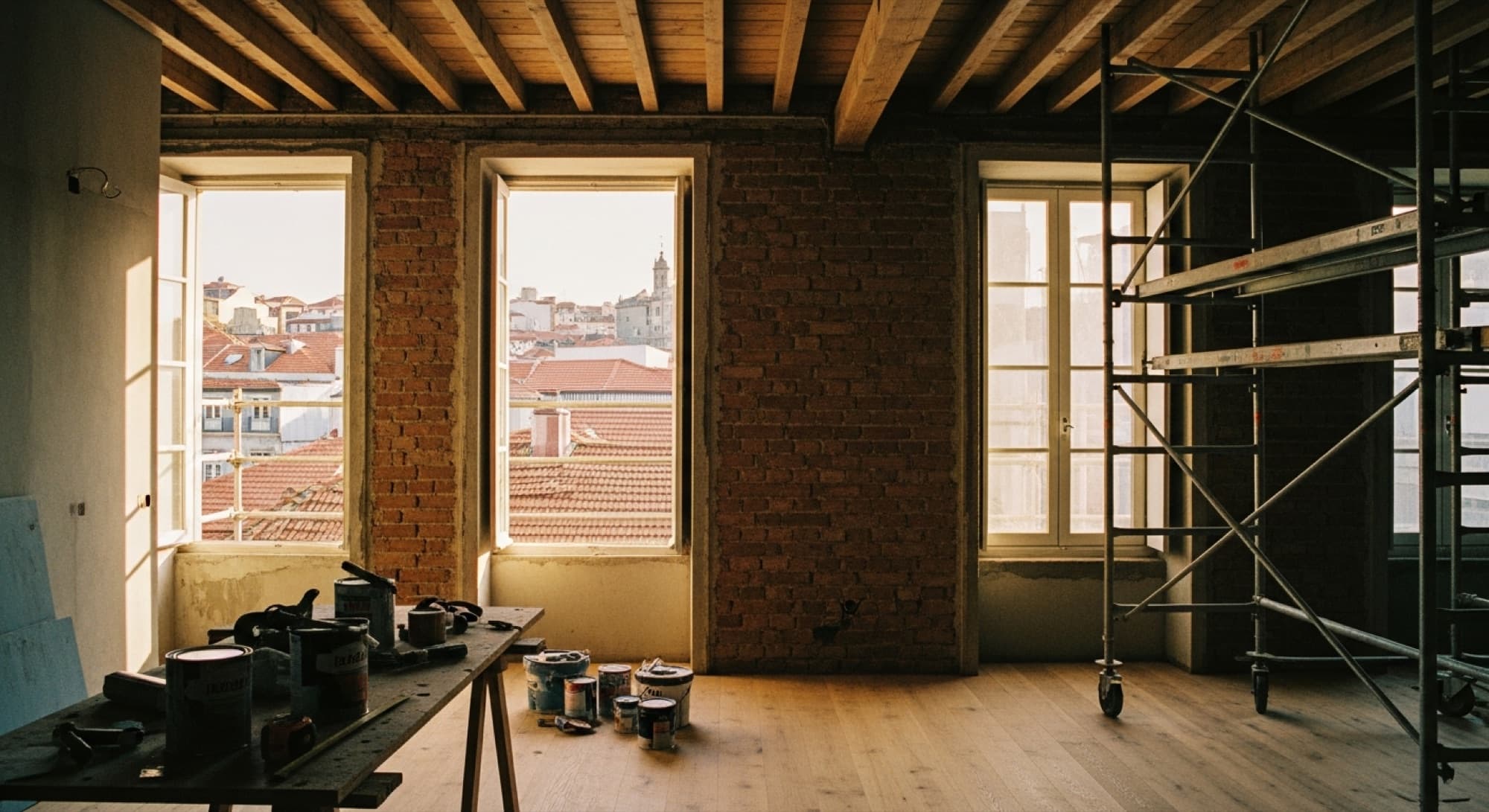
Last updated: May 2026. Portugal can still work for house flipping, but only if the spreadsheet is colder than the sales pitch. The easy 2017 to 2021 Lisbon trade is gone. In 2026, profit comes from buying legal defects, layout problems, inherited stock, and tired apartments in liquid micro-markets, then controlling tax, obra, financing, and resale timing with discipline.
What this guide covers
- Why Portugal still attracts flip capital, and where Spain, France, and Italy look better
- How to adapt the 70% rule for IMT, AMI commission, escritura, legal fees, and mais-valias
- Renovation costs by city, from light refresh to full structural obra
- Permitting, licença, comunicação prévia, and what blocks a flip
- Bridge finance, foreign buyer mortgages, and refinance exits after renovation
- The tax math: IMT, IMI, AIMI, IVA, capital gains, NHR, and IFICI
- A worked €180,000 to €280,000 Porto flip, month by month
- The mistakes that turn a Portuguese flip into a long rental
- Frequently asked questions
- Sources
Why Portugal for flipping in 2026?
The honest answer is not that Portugal is cheap. Central Lisbon is no longer cheap, prime Cascais never was, and the Algarve coast now prices much of its best stock like a mature international second-home market. The case for flipping Portugal in 2026 is narrower and more technical: old housing stock, fragmented ownership, slow local sellers, strong foreign-buyer liquidity, and a renovation market where the difference between a tired apartment and a clean, bankable, photographed product can still be €1,000 to €2,500 per m² in the right street.
Portugal also remains easy to own as a foreigner. There are no nationality restrictions on buying, selling, renting, or holding property. A non-resident needs a NIF, a Portuguese bank account, a lawyer, and clean source-of-funds documents. For the full acquisition process, see our complete buyer guide for foreigners buying property in Portugal.
Compared with Spain, Portugal has a smaller market but fewer regional legal layers. Compared with France, paperwork is lighter. Compared with Italy, Portugal is easier for non-resident banking and resale to English-speaking buyers. Spain often wins on scale, France on mortgage depth, and Italy on raw entry price. Portugal wins when you buy an under-presented asset in Porto, Setúbal, Braga, Faro, Olhão, Coimbra, or the outer Lisbon rail corridor and resell to a buyer who wants a turnkey home without managing obra.
The post-NHR reality matters. The original NHR regime closed to new entrants on 31 December 2023. IFICI is narrower and aimed at qualifying scientific, academic, and innovation work. Underwrite against real end-user demand, not a fantasy of endless tax-motivated retirees.
The best 2026 flip thesis is not "Portugal always goes up." It is: buy below the finished comparable, fix a real defect, finish to the standard the resale buyer expects, and leave enough margin for tax drag and time.
The 70% rule, adapted to Portuguese costs
The American 70% rule says the maximum purchase price should be 70% of after-repair value, minus renovation cost. In Portugal, that formula is too generous because acquisition and exit costs sit heavily on the deal. A Portuguese flip must pay IMT, 0.8% stamp duty, notary and registration, legal fees, renovation IVA in many invoices, holding costs, possible bank fees, AMI sales commission on exit, and capital gains tax. The usable version is closer to a 62% to 68% rule, depending on city, buyer profile, and whether the seller pays the agency commission on resale.
Start with after-repair value, or ARV. This is not the highest Idealista asking price in the freguesia. It is the price at which a renovated property of the same typology, lift status, floor, light, parking, energy class, and location is likely to sell inside 90 to 150 days. In thin markets, discount asking prices by 5% to 12%.
The Portugal flip formula we use
Maximum purchase price = ARV minus renovation budget minus purchase costs minus sale costs minus tax reserve minus target profit.
For a small apartment flip, a practical target profit reserve is usually 12% to 18% of total cash invested. Below that, one permit delay or one weak appraisal can erase the trade. If you are using debt, use cash-on-cash ROI, not headline profit. If you are all cash, use both absolute profit and annualized return. A €35,000 net profit after 14 months is not the same result as €35,000 after 6 months.
| Cost item | Typical 2026 range | How it hits a flip |
|---|---|---|
| IMT on purchase | 0% to 8% progressive, or flat bands above high thresholds | Paid before escritura. Investment and second-home treatment is usually less favorable than primary residence treatment. |
| Stamp duty on purchase | 0.8% of price | Always budget it. It is separate from mortgage stamp duty. |
| Legal, notary, registration | €2,000 to €5,000 on small to mid-market deals | Do not economize on legal due diligence. Bad title or illegal obra kills resale. |
| AMI resale commission | 5% plus 23% IVA is common | Usually paid by the seller, which means you when you exit. |
| Capital gains tax reserve | Depends on residence and structure | Reserve before declaring victory. Mais-valias can turn a pretty gross profit into an average net return. |
If the deal only works with zero resale commission, perfect permits, a top-quartile sale price, and no capital gains tax, it does not work. Portugal rewards conservative underwriting because the administrative delays are real.
Renovation costs by city and project type
Renovation pricing in Portugal varies by city, building age, access, contractor quality, and whether you touch structure, plumbing stacks, electrical risers, roof, façade, or condominium common parts. As a May 2026 underwriting range, a cosmetic refresh can sit around €300 to €600 per m², a mid-level apartment renovation often lands at €700 to €1,200 per m², and a full gut with new systems can run €1,200 to €2,000 per m². Luxury, heritage, seismic, and roof projects can exceed €2,500 per m².
Lisbon and Cascais are the most expensive because labor demand, access, waste removal, condominium constraints, and buyer finish expectations are all higher. Porto is cheaper than Lisbon but no longer a bargain for skilled trades. The Algarve is split: Faro and Olhão can price below Lisbon, while Lagos and prime Tavira can price like an international resort market.
| Market | Light refresh | Mid-level renovation | Full gut or heavy obra | Flip note |
|---|---|---|---|---|
| Lisbon, Cascais | €450 to €750/m² | €1,000 to €1,700/m² | €1,700 to €2,800/m² | Only works where resale comps are deep. Elevators, light, and parking matter. |
| Porto, Vila Nova de Gaia | €400 to €650/m² | €850 to €1,400/m² | €1,400 to €2,300/m² | Good stock, but historic buildings can hide roof and structure risk. |
| Algarve | €400 to €700/m² | €900 to €1,600/m² | €1,500 to €2,600/m² | Seasonality hurts scheduling. Resort buyers punish mediocre finishes. |
| Setúbal, Braga, Coimbra | €350 to €600/m² | €700 to €1,150/m² | €1,100 to €1,900/m² | Often the best balance of entry price, renovation cost, and resale depth. |
| Interior Portugal | €300 to €550/m² | €650 to €1,100/m² | €1,000 to €1,800/m² | Cheap entry does not mean fast exit. Use rental yield as a backup plan. |
For underwriting, add a contingency of 12% to 20% to the contractor quote. Use the higher end for pre-1951 buildings, top-floor apartments, roof work, structural walls, damp, illegal mezzanines, and protected zones. If you are not in Portugal during the obra, budget 6% to 10% of renovation spend for project management or fiscalização.
Permitting and obras: what needs a licença?
Portugal does not treat every renovation the same. Painting, floor replacement, kitchen replacement, bathroom refreshes, and non-structural finishes are usually works of escassa relevância urbanística or simple maintenance, depending on municipality and building. Changing structure, façade, roof, external openings, use, floor area, number of units, heritage elements, or building systems can require comunicação prévia or a formal licença de obras. In historic centers, ARU zones, and protected buildings, the answer can change by street.
The worst flip mistake is buying a property where the current floor plan does not match the caderneta predial, land registry, or municipal records, then assuming the discrepancy can be legalized later. Sometimes it can. Sometimes the building has exhausted permitted area, the condominium refuses approval, or the property lacks a valid licença de utilização.
Practical timeline
- Cosmetic apartment refresh: 4 to 10 weeks of work, often no formal license, subject to condominium rules and municipal noise rules.
- Full apartment renovation without structural change: 3 to 6 months including design, contractor booking, works, inspections, and snagging.
- Structural change, façade, roof, or layout legalization: 6 to 18 months depending on Cãmara, architect workload, and whether heritage review applies.
- Change of use or unit subdivision: 9 to 24 months and only worth underwriting if the discount is large enough to pay for failure risk.
Before CPCV, your lawyer should confirm ownership, liens, energy certificate, habitation license, condominium debts, and whether visible works were licensed. Your architect should review the floor plan, structure, façade, and municipal constraints before you release a non-refundable sinal. Condominium approval is a separate risk for shafts, exterior AC units, windows, scaffolding, roof works, and common parts.
Financing a flip: cash, bridge loans, and exit mortgages
The cleanest Portuguese flip is still bought with cash. Sellers of distressed or inherited property prefer certainty, banks dislike uninhabitable collateral, and renovation funding for non-residents is less standardized than in the US or UK. That said, financing is possible if you match the instrument to the stage of the deal.
Standard Portuguese mortgages usually fund against habitable property, not speculative renovation. Millennium BCP, Novobanco, BPI, Santander Totta, CGD, and Bankinter all lend to foreign buyers, but underwriting is built around income, LTV, valuation, and legal habitability. A non-EU non-resident commonly sees 60% to 70% LTV on a normal purchase, while a Portuguese tax resident or EU buyer may see higher LTV. For rate mechanics and bank-by-bank detail, see our Portugal mortgage rates guide for foreign buyers.
Common financing structures
- All cash acquisition plus cash renovation: fastest and strongest for negotiation. Best for auctions, inheritance sales, and properties that banks will not finance.
- Mortgage purchase plus cash renovation: works when the property is habitable and legal at acquisition. The bank may ignore your planned uplift until refinance.
- Construction or renovation loan: possible, but slower. Banks release funds in tranches against invoices or progress inspections.
- Bridge loan or private credit: available through brokers and private lenders, usually expensive. Use only when the resale market is liquid and the exit is credible.
- Equity release exit: after renovation and valuation, refinance or remortgage to release capital, then hold as a rental instead of selling.
Bankinter Consumer Finance and other consumer-credit channels can fund small works, but consumer credit is rarely appropriate for a professional flip because rates, term, and limits are worse than secured lending. If a flip needs expensive unsecured debt to work, the purchase price is probably too high.
The exit matters before you buy. A resale exit needs a buyer who can get a mortgage on the finished product, which means legal documentation, clean energy certificate, registered areas that match reality, and finishes that appraise well. A rental refinance exit needs yield. Porto, Setúbal, Braga, Coimbra, and parts of Faro often underwrite more cleanly than luxury Lisbon or prime Algarve. Our Lisbon versus Porto investment comparison goes deeper on that trade-off.
Tax math: IMT, IMI, IVA, mais-valias, NHR, and IFICI
Taxes are where many Portugal flip spreadsheets become fiction. The acquisition tax is not a rounding error. IMT is progressive for residential property and depends on use, location, and price band. Stamp duty on the acquisition is 0.8%. Annual IMI is commonly 0.3% to 0.45% of VPT for urban property, with the exact rate set by the municipality. AIMI can apply when Portuguese real estate VPT exceeds €600,000 per individual or €1.2 million for a couple, with higher bands above that.
Capital gains, or mais-valias, need advice before purchase, not after sale. Individuals, companies, residents, and non-residents can be taxed differently. Residents may have reinvestment relief when selling a qualifying main home, but that is usually irrelevant to a professional flip. Model tax with a Portuguese accountant and reserve cash.
There is also IVA. Many renovation invoices carry 23% IVA, though reduced rates may apply to certain qualifying urban rehabilitation works. Contractors who offer a cash price without proper invoice can create a resale problem and weaken your deductible cost base for capital gains.
NHR is not a flip strategy in 2026. The old regime closed to new applicants at the end of 2023. IFICI is narrower and not designed for property traders. Golden Visa is also not a real estate flip strategy: the real estate route was removed in October 2023. If residency planning sits alongside your property plan, read our Portugal Golden Visa guide, but do not buy a flip expecting the property itself to grant residency.
Get the NIF early. You need it for banking, CPCV, tax payments, utilities, and many contractor accounts. Our Portugal NIF guide for Americans explains the remote process, fiscal representative issue, and timing.
Worked example: a €180,000 to €280,000 Porto flip
Here is a conservative example based on the kind of small Porto apartment deal that still appears in Bonfim, Campanhã edge streets, Paranhos, or Vila Nova de Gaia when the seller wants speed and the apartment photographs badly. It is a tired T1 plus one, second floor, no lift, legal habitation license, decent light, close to metro, old kitchen, old bathroom, weak flooring, and no structural work.
| Line item | Amount | Assumption |
|---|---|---|
| Purchase price | €180,000 | Negotiated from €195,000 asking after legal and renovation diligence. |
| Purchase taxes and closing | €12,500 | IMT, 0.8% stamp duty, notary, registration, lawyer. |
| Renovation budget | €47,000 | About €940/m² on 50 m², including kitchen, bath, electrical refresh, floors, windows, paint. |
| Contingency | €7,500 | 16% of renovation budget. |
| Holding and utilities | €3,000 | Condominium, IMI accrual, insurance, utilities, cleaning, staging gap. |
| Resale commission | €17,220 | 5% plus 23% IVA on a €280,000 sale. |
| Expected resale price | €280,000 | Based on renovated comps, not top asking prices. |
Total cash before tax reserve is €267,220. Gross profit before capital gains tax is €12,780. That is not enough. Many portal spreads collapse once Portuguese transaction friction is included.
To make this deal investable, one of three things must change. The purchase price falls to around €160,000, the resale price has credible support closer to €300,000, or the renovation scope falls without weakening resale. At a €160,000 purchase, the same works and a €280,000 exit produce about €30,680 before tax reserve.
Month-by-month timing
- Month 1: offer, due diligence, CPCV, contractor walk-through, architect check if layout changes.
- Month 2: escritura, final measurements, materials ordering, demolition.
- Months 3 to 5: electrical, plumbing, bathroom, kitchen, windows, flooring, painting.
- Month 6: snagging, cleaning, staging, photography, energy certificate update if needed.
- Months 7 to 9: resale marketing, negotiation, buyer mortgage valuation, CPCV.
- Months 9 to 11: escritura and capital release, longer if the buyer has complex financing.
The lesson is that the purchase discount must pay for Portuguese friction. If the seller wants retail price for an unrenovated apartment, your profit is already gone.
The six mistakes that kill flip ROI in Portugal
- Using asking prices as ARV. Idealista is an asking-price database, not a closing-price database. In slower markets, ask your agent for sold evidence, bank valuation comparables, and realistic days-on-market.
- Ignoring legal area. If the terrace, attic, basement, mezzanine, or extra bedroom is not legal, it may not appraise or resell at the number in your spreadsheet.
- Buying a permit file instead of a property. Layout changes, façade works, roof repairs, and unit splits can be profitable, but only when priced as planning risk.
- Underbudgeting trades. A quote at €700/m² for a full Lisbon gut renovation should make you ask what is missing. Good labor is not cheap in 2026.
- Choosing finishes for Instagram rather than the buyer. A resale buyer wants light, storage, acoustic comfort, clean bathrooms, reliable appliances, and a sensible kitchen. Expensive decorative choices rarely appraise.
- Forgetting the exit buyer's mortgage. If the finished home cannot pass bank valuation, legal checks, energy certification, and buyer affordability, your cash buyer pool is much smaller.
A seventh mistake is emotional: falling in love with ruins. Most are lifestyle projects, hospitality projects, or multi-year development projects. A flip needs speed, certainty, and a buyer pool that already exists.
When not to flip: rental yield versus resale profit
Sometimes the right answer is to hold. If the property produces a credible long-term gross yield of 5.5% to 7.0% after renovation, has legal rental status, and sits in a durable rental market, forcing a quick sale may be inferior to refinancing or holding through the next rate cycle. Porto, Setúbal, Braga, Coimbra, and Faro can support this logic. Prime Lisbon and prime Algarve often do not, because entry prices are too high relative to rent.
A flip is strongest when the renovation creates immediate buyer value that the rental market will not fully pay for. A hold is stronger when the acquisition basis is low, demand is stable, and the renovated asset can carry itself. In the Algarve, short-term rental regulation, seasonality, licensing, and management costs can change the answer street by street. Our Algarve real estate investment guide for foreigners covers that market in more detail.
Do not flip just because a property is ugly. Flip when the ugly part is fixable, the legal part is clean, the resale buyer is identifiable, and the margin survives a lower sale price, a slower buyer mortgage, and a contractor invoice that comes in 15% higher than expected.
Frequently asked questions
Is house flipping profitable in Portugal in 2026?
Yes, but the margin is narrower than old articles suggest. A viable small flip usually needs a purchase discount of 15% to 25% below finished comparable value after adjusting for renovation, IMT, stamp duty, legal fees, resale commission, holding costs, and tax reserve.
What is the best city in Portugal for house flipping?
Porto, Vila Nova de Gaia, Setúbal, Braga, Coimbra, Faro, and selected Lisbon rail-corridor markets often underwrite better than prime Lisbon or prime Algarve. Lisbon is liquid, but the entry price and renovation cost leave less room for error.
How much does it cost to renovate a house in Portugal?
As a 2026 underwriting range, cosmetic work is often €300 to €750 per m², mid-level apartment renovation is €700 to €1,700 per m², and full heavy obra can run €1,200 to €2,800 per m², depending on city and scope.
Do foreigners pay more tax when flipping Portuguese property?
Foreigners do not pay a special purchase tax just for being foreign, but tax residence, ownership structure, and capital gains treatment matter. Non-residents should model Portuguese mais-valias with an accountant before buying.
Can I get a mortgage for a property I plan to renovate?
Sometimes. Banks prefer habitable, legal collateral. A non-resident can often finance 60% to 70% LTV on a normal purchase, but derelict or illegal properties may require cash, staged renovation finance, or private bridge lending.
Do I need a permit for renovations in Portugal?
Not for every renovation. Cosmetic work is often simple, but structure, façade, roof, area changes, unit subdivision, use changes, and heritage-zone works can require comunicação prévia or licença de obras. Always check before CPCV.
What return should I target on a Portugal flip?
We would not underwrite a small foreign-investor flip below 12% to 18% target return on total cash invested before final tax, unless there is a strong rental backup plan. Lower margins are too easy to lose to time and friction.
Is the Golden Visa available through a house flip?
No. The real estate route for Portugal Golden Visa was removed in October 2023. Buying, renovating, or flipping a property does not create Golden Visa eligibility in 2026.
Sources
- Autoridade Tributária e Aduaneira, Portal das Finanças, IMT, IMI, AIMI, stamp duty, tax codes, and official taxpayer guidance used for purchase-cost and holding-tax ranges.
- Banco de Portugal, Statistics, housing credit rates, mortgage stock, and bank lending context for non-resident financing assumptions.
- European Central Bank, euro-area reference-rate context used for Euribor-linked mortgage discussion.
- INE, Instituto Nacional de Estatística, Portuguese housing price index, regional price trends, construction indicators, and demographic context.
- Eurostat Housing Price Statistics, comparative European housing-price and cost context for Portugal versus Spain, France, and Italy.
- Idealista Price Index Portugal, asking-price ranges by district and municipality used as a market-sentiment input, not as closed-sale evidence.
- Confidencial Imobiliário, transaction-price and market-liquidity reporting referenced for resale-market caution and regional spread assumptions.
- IMPIC, AMI mediation licensing and real estate activity oversight used for agency and commission context.
- Lei 56/2023, Diário da República, legal basis for removal of the real estate route from Portugal Golden Visa.
- Câmara Municipal de Lisboa, municipal urbanism, licensing, ARU, and IMI context for Lisbon renovation risk.
- Câmara Municipal do Porto, municipal planning and licensing context for Porto renovation and resale timing.
- ECO, Portuguese real estate, tax, mortgage, and macroeconomic reporting used for 2025 to 2026 market context.
- Idealista News Portugal, renovation-cost reporting, market commentary, and regional buyer-demand context.
Take the next step
Ready to buy in Portugal?
Tell us your budget, target region, and timeline. You will get a personalized buying plan with realistic property matches and a total-cost projection.
Start free assessmentArticle slug: portugal-house-flipping-guide-calculator