Apartments for Sale in Portugal: The Complete Foreign Buyer Guide (2026)
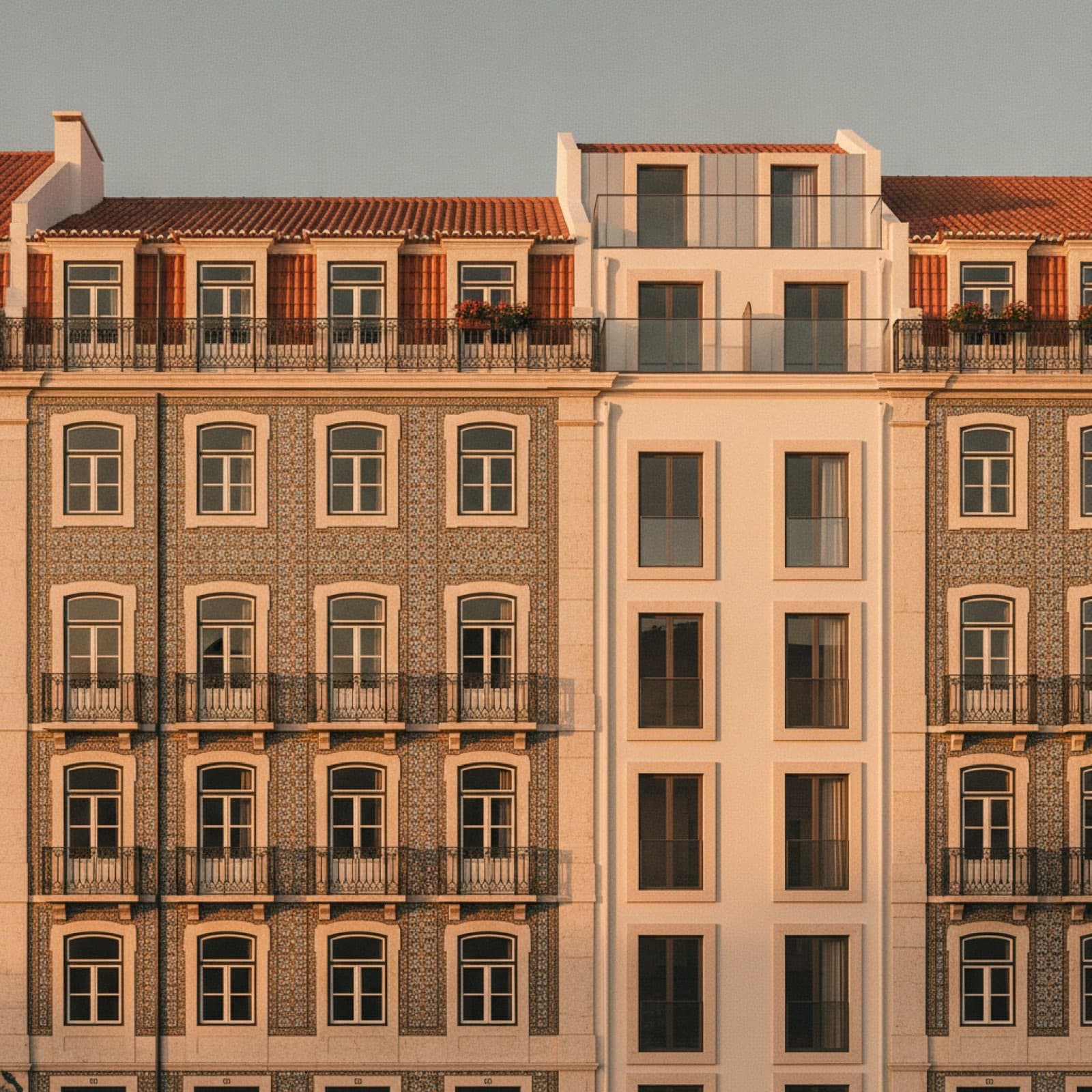
Last updated: July 2026. Most foreigners who buy in Portugal end up buying an apartment, not a villa. Apartments are what Lisbon, Porto, and the coastal towns are actually made of, they are easier to lock and leave, and they are where the rental demand sits. Yet almost every guide online is written as if everyone is buying a farmhouse with land. This one is specifically about buying an apartment in Portugal as a foreigner: where it makes sense, what it really costs, what the condominio means for you, and the traps that are specific to apartment deals.
The fast answer: Any foreigner can buy an apartment in Portugal with the same rights as a Portuguese citizen. Budget 7 to 9 percent on top of the price for IMT, stamp duty, and fees, plus a monthly condominio fee once you own. Non-EU buyers finance at 60 to 70 percent loan-to-value. Median asking prices run from roughly 3,400 EUR per square metre in Porto to about 4,900 EUR in Lisbon and 5,700 EUR in Cascais. The purchase takes 8 to 16 weeks end to end.
What this guide covers
- Can foreigners buy an apartment in Portugal?
- Where apartments make sense: city by city
- New-build vs resale
- The condominio: fees, rules, and the paperwork
- What an apartment really costs at purchase
- Financing as a non-resident
- The buying process, compressed
- Renting it out: the honest picture
- Seven apartment-specific pitfalls
- Frequently asked questions
- Sources
Can foreigners buy an apartment in Portugal?
Yes, without restriction. Portugal places no nationality conditions on owning residential property, and an apartment is no different from a house in that respect. You do not need residency, you do not need to be in the country for the closing, and you hold the same ownership rights as a Portuguese citizen, including the right to sell, rent, and pass the property to heirs.
The practical requirements are the same ones every foreign buyer meets: a Portuguese tax number (NIF), a Portuguese bank account, and an independent lawyer. If you want the full eligibility picture, including buying remotely by power of attorney, our dedicated guide covers it: can foreigners buy property in Portugal?
One thing that is different for apartments: you are not just buying a unit, you are buying a fraction of a building. That fraction comes with a monthly fee, a set of rules, and neighbours who vote. The whole middle of this guide is about exactly that.
Where apartments make sense: city by city
Portugal's apartment stock is concentrated where foreigners want to be anyway: Lisbon, Porto, the Algarve towns, and the Lisbon coast. The table below shows median asking prices per square metre from our region tracking, which follows the INE residential price index and Idealista asking-price data. Treat these as orientation, not gospel: within Lisbon alone, the spread between Marvila and Chiado is more than double.
| Area | Median asking price (EUR/m²) | Typical gross yield | Who buys here |
|---|---|---|---|
| Cascais | ~5,700 | ~4.1% | Lifestyle buyers, families, executives |
| Lisbon | ~4,900 | ~4.5% | Investors, remote workers, city buyers |
| Algarve | ~3,600 | ~4.8% | Sun seekers, holiday-let investors |
| Porto | ~3,400 | ~4.7% | Value buyers, yield investors, students' parents |
| Madeira (Funchal) | ~3,100 | ~4.6% | Remote workers, retirees, D7 movers |
What that means in whole numbers: a renovated 70 m² one-bedroom runs roughly 340,000 EUR in central Lisbon, about 240,000 EUR in Porto, and often under 200,000 EUR in secondary cities like Braga, Coimbra, or Aveiro, where the Idealista index quotes asking prices well below the big-city level. The interior is cheaper still, but the rental market thins out fast once you leave the coast and the university cities.
Lisbon
The deepest market and the most liquid exit. Prime central parishes (Chiado, Príncipe Real, Estrela) are mature: buy there for stability and quality of life, not for 2018-style appreciation. Emerging districts like Marvila and Beato, and the Almada side of the river, still price meaningfully below the centre. Our Lisbon investment guide breaks the city down parish by parish.
Porto
Roughly 30 percent cheaper than Lisbon with comparable rental demand from students, tourism, and a growing tech scene. Vila Nova de Gaia, across the river, gives river views at a discount. Porto is where the numbers most often still work for yield-driven buyers.
The Algarve
Apartment buying in the Algarve is mostly about holiday use and holiday lets: Vilamoura, Lagos, Albufeira, Tavira. Buildings are newer on average, condominio fees are higher when there are pools and gardens, and rental income is seasonal. Our Algarve guide for foreign buyers covers the region town by town.
The secondary cities
Braga, Coimbra, Aveiro, and Setúbal offer the lowest entry prices for habitable apartments in cities with real economies. They suit buyers who want a base in Portugal without Lisbon money, and landlords targeting long-term local tenants rather than tourists.
New-build vs resale
Portugal's apartment stock splits into three very different products, and the due-diligence work is different for each.
Resale in an older building (pre-1990s)
The classic azulejo-fronted building with character and, often, no elevator and no insulation. Prices look attractive per square metre. The risk sits in the building, not the unit: deferred maintenance on the roof and facade becomes your bill through the condominio, and older buildings may lack a formal condominio administration entirely. Always have your lawyer pull the building's condominio minutes and accounts, and confirm the habitation licence (licença de utilização) and energy certificate before the CPCV.
Resale in a modern building (1990s onward)
The lowest-drama option. The building has an administration, reserve funds, and an elevator. You pay for that in the price and in a higher monthly fee. This is what most foreign buyers who plan to lock and leave should target.
New-build from a developer
You typically reserve off-plan, sign a CPCV, and pay in stages during construction, with the balance at the deed. Three protections matter: the deposit schedule should be as back-loaded as you can negotiate, the CPCV should carry a clear delivery deadline with penalties, and the developer's bank guarantee or insurance on advance payments should be verified by your lawyer, not taken on faith. Snagging (vistoria) before the deed is standard: you inspect, list defects, and the developer fixes them. New builds come with better energy ratings and lower maintenance for the first decade, at a price premium over resale in the same area.
Watch out: in a new development, the condominio fee quoted in the sales brochure is an estimate set before the building has ever run a full year. Pools, gyms, and concierge desks are expensive to operate. It is common for the fee to rise meaningfully once the real operating costs land.
The condominio: fees, rules, and the paperwork
Every apartment in Portugal sits inside a condominio, the legal structure through which owners share the building. It is the single biggest difference between buying an apartment and buying a house, and it is where apartment-specific surprises live.
The monthly fee
Each unit pays a share of the building's running costs (cleaning, electricity for common areas, elevator maintenance, insurance, administration) in proportion to its permilagem, the fraction of the building it represents. For a simple building without an elevator, fees commonly run a few tens of euros a month. For a modern building with elevator, garage, and shared areas, budget roughly 50 to 150 EUR a month. Resort-style buildings with pools and gardens, common in the Algarve, can run meaningfully higher. The exact number is in the building's budget, which your lawyer should obtain before you sign anything.
The paperwork your lawyer must pull
- Declaration of no condominio debt: unpaid condominio charges attach to the unit. Since the 2022 reform of the condominio law, the seller must present a declaration of the unit's charges and any debt at the deed. Your lawyer confirms it is clean, or the debt is settled from the sale price.
- Minutes of recent assemblies: the atas reveal what is coming: an approved roof renovation, a dispute over the elevator, a special assessment (quota extraordinária) that the seller would love you to inherit.
- Reserve fund status: a building with no reserves pays for its roof with special assessments. A building with healthy reserves already collected the money.
- The building rules (regulamento): some regulamentos restrict short-term rental, pets, or commercial use. If your plan is Airbnb, this document can kill it regardless of what the municipality allows.
Your vote
Owners vote in the annual assembly in proportion to permilagem. As a foreign owner you can attend remotely or grant a proxy. Ignoring the assembly is how you wake up to a facade renovation you did not budget for.
What an apartment really costs at purchase
Transaction costs for a foreign buyer in Portugal run 7 to 9 percent on top of the purchase price with a mortgage, closer to 6 to 7 percent in cash. Apartments follow exactly the same tax table as houses. The components:
- IMT (transfer tax): progressive on the higher of price or tax value (VPT). The table below.
- Stamp duty (Imposto do Selo): 0.8 percent of the price, flat.
- Notary and registration: 1 to 1.5 percent combined, often capped around 1,200 to 2,500 EUR in practice.
- Legal fees: around 1 percent, or a flat 1,500 to 3,500 EUR for a straightforward deal.
- Mortgage origination (if financing): roughly 1 percent of the loan plus a 250 to 450 EUR valuation.
IMT brackets for a primary residence, mainland Portugal (2026)
| Purchase price bracket | Marginal rate | Deduction |
|---|---|---|
| Up to €101,917 | 0% | €0 |
| €101,917 to €139,412 | 2% | €2,038 |
| €139,412 to €190,086 | 5% | €6,221 |
| €190,086 to €316,772 | 7% | €10,022 |
| €316,772 to €633,453 | 8% | €13,190 |
| €633,453 to €1,102,920 | 6% flat | n/a |
| Over €1,102,920 | 7.5% flat | n/a |
Worked example: a 300,000 EUR one-bedroom in Porto bought as a primary residence. IMT = (300,000 × 7%) − 10,022 = 10,978 EUR. Stamp duty = 2,400 EUR. Add notary, registration, and legal, and the all-in lands around 318,000 to 322,000 EUR before furniture. Second homes pay a higher IMT scale in the lower brackets, which matters if this apartment is a holiday base rather than your main residence. Run your own numbers in the IMT calculator, and see the full cost stack in our cost-to-buy guide. Brackets are updated annually by the Autoridade Tributária; confirm the current table before you sign.
Heads up: the IMT rules change on 25 May 2026. Under Decreto-Lei n.º 97/2026 (published 20 May 2026), a buyer who is not a Portuguese tax resident pays a flat 7.5 percent IMT on urban residential property for deeds signed since 25 May 2026, instead of the progressive scale above. On the 300,000 EUR Porto example, that is 22,500 EUR instead of 10,978 EUR. The difference can be cancelled or refunded if you become a Portuguese tax resident within two years of the purchase, or if you put the home into long-term moderate-rent housing (rent up to 2,300 EUR a month, a lease within 6 months held for at least 36 months). Two practical consequences: a non-resident mid-purchase saves real money by signing the escritura before 25 May 2026, and anyone planning to relocate should document the residency timeline with their lawyer to claim the difference back.
Financing as a non-resident
Portuguese banks lend to non-resident foreigners on tighter terms than to residents: 60 to 70 percent loan-to-value for non-EU buyers, 80 to 90 percent for EU residents. That means a non-EU buyer of a 300,000 EUR apartment should plan a down payment of 90,000 to 120,000 EUR plus costs.
Pricing is competitive by US and UK standards: variable loans price off Euribor plus a spread, and Banco de Portugal publishes the running averages. Get a written pre-approval (pré-aprovação) before making offers; in Lisbon and Cascais, sellers do not take unfinanced offers from foreigners seriously without one. Model your monthly payment in the mortgage calculator, and see the full lender-by-lender picture in our non-resident mortgage guide.
One apartment-specific financing note: banks value the unit including its permilagem of the building, and a valuation can come back low in older buildings with visible deferred maintenance. If the valuation comes in under the agreed price, the LTV applies to the lower number, and the difference comes from your pocket. Protect yourself with a financing condition in the CPCV.
The buying process, compressed
The apartment purchase follows the same sequence as any Portuguese property deal. In brief: NIF and bank account, independent lawyer, reservation and due diligence, CPCV with a 10 to 30 percent deposit, then the escritura before a notary, with IMT and stamp duty paid that morning. Cash buyers close in 6 to 8 weeks; mortgage buyers should plan 12 to 16. The full sequence, document by document, is in our step-by-step buying process guide and, at full depth, in the complete buyer guide.
The apartment-specific additions to the standard checklist: the condominio debt declaration, the assembly minutes, the reserve-fund status, the regulamento, and confirmation that any terrace, storage room, or parking space you think you are buying is actually registered as part of the unit (or as an annex with its own registration) rather than being common area the seller has been using informally.
Free 2-minute assessment
Tell us your budget, target city, and timeline. We will send you a personalized apartment-buying plan with a realistic total cost projection and an introduction to the lawyer and bank we would use for your case.
Renting it out: the honest picture
Two different businesses, two different rulebooks:
Long-term rental
Open to any owner, no licence required. Contracts are regulated, tenants are well protected, and non-residents pay Portuguese tax on net rental income (25 percent for non-residents, with documented expenses deductible). Yields in the table above are gross; after condominio, IMI, insurance, maintenance, and tax, realistic net yields sit meaningfully lower. Boring, stable, and what the secondary cities are best at.
Short-term rental (Alojamento Local)
This is where you must do the homework before you buy, not after. Short-term letting requires an AL registration, and since 2024 the rules put municipalities back in control: many central zones in Lisbon and Porto restrict new AL registrations, while much of the Algarve and the interior remains open. Two consequences for apartment buyers specifically:
- An existing, transferable AL registration attached to the unit can carry real value in a restricted zone; its transferability rules have changed more than once, so have your lawyer verify the current status rather than pricing it on the listing agent's word.
- Even where the municipality allows AL, the building can say no: condominio assemblies have legal standing to oppose short-term rental in the building, and some regulamentos exclude it outright.
Do not underwrite the purchase on Airbnb income you have not verified. If the deal only works with short-term rental, confirm the AL position in writing with the câmara municipal and read the building's regulamento before the CPCV, and stress-test the numbers against a long-term rental as the fallback.
Seven apartment-specific pitfalls
- Buying the unit, ignoring the building. The roof, the facade, and the elevator are collectively yours now. Read the minutes and the reserve-fund position before the CPCV, not after the first special assessment.
- Inheriting condominio debt. Insist on the no-debt declaration at the deed. Unpaid charges follow the unit.
- Unregistered "extras". Terraces, arrecadações (storage rooms), and parking spaces are sometimes common property used informally. If it is not in the registration documents, you are not buying it.
- Assuming Airbnb is allowed. Municipality and condominio both have a say. Verify both in writing.
- Trusting the brochure condominio fee in a new build. It is an estimate. Real operating costs arrive in year one.
- Skipping the habitation licence check in older buildings. No licença de utilização, no legal dwelling, and banks will not lend on it.
- Buying the top floor without pricing the elevator. Character walk-ups are charming at 35 and a resale problem at 65. Buildings without elevators trade at a discount for a reason, on both entry and exit.
Frequently asked questions
Can a foreigner buy an apartment in Portugal?
Yes, with no restrictions and no residency requirement. You need a NIF, a Portuguese bank account, and an independent lawyer, and you can complete the whole purchase remotely by power of attorney.
How much does an apartment cost in Portugal in 2026?
Orientation numbers: about 4,900 EUR per m² median asking in Lisbon, 3,400 EUR in Porto, 3,600 EUR in the Algarve. A renovated 70 m² one-bedroom is roughly 340,000 EUR in central Lisbon, 240,000 EUR in Porto, and often under 200,000 EUR in Braga, Coimbra, or Aveiro. Add 7 to 9 percent on top for taxes and fees.
What is the condominio fee, and how high is it?
It is your unit's monthly share of the building's running costs. Simple buildings: a few tens of euros. Modern buildings with elevator and garage: commonly 50 to 150 EUR a month. Resort buildings with pools: more. The building's budget has the exact number; ask for it before the CPCV.
Can I get a mortgage as a non-resident?
Yes: 60 to 70 percent LTV for non-EU buyers, 80 to 90 percent for EU residents, priced off Euribor plus a spread. Get a written pre-approval before offering, and keep a financing condition in the CPCV in case the bank's valuation comes in low.
Can I rent my apartment on Airbnb?
Only if the municipality allows a new Alojamento Local registration in that zone and the building does not oppose it. Both checks happen before you buy, in writing. If the deal only works with short-term rental income, that is a red flag.
Should I buy new-build or resale?
Lock-and-leave buyers are usually best served by resales in modern buildings. Yield buyers find better numbers in older stock, priced for the building risk. New builds suit buyers who value energy performance and warranty, and who have a lawyer verifying the developer's guarantees on advance payments.
What changes on 25 May 2026?
Non-resident buyers pay a flat 7.5 percent IMT on urban residential property instead of the progressive scale (Decreto-Lei 97/2026), with the difference cancellable if they become Portuguese tax residents within two years or lease the home at moderate rent. Deeds signed before that date keep the progressive scale.
What ongoing costs should I budget after buying?
The condominio fee, annual IMI (0.3 to 0.45 percent of the tax value), building insurance for your unit, utilities, and, if you rent it out, 25 percent Portuguese tax on net rental income as a non-resident.
Ready to look at real apartments?
Tell us your budget and target city. We will send a realistic total cost projection for the apartments in your range and introduce you to the lawyer and bank we would use for your specific case. Two minutes, no obligation.
Sources
- INE, Instituto Nacional de Estatística, residential property price index by region and municipality.
- Idealista Price Index, asking-price data by district and parish.
- Autoridade Tributária e Aduaneira, Portal das Finanças, IMT, IMI, AIMI tables and stamp duty rates.
- Banco de Portugal, Statistics, new housing loan rates and mortgage stock.
- Diário da República, condominio law reform and Alojamento Local legislation.
- Câmara Municipal de Lisboa, Alojamento Local zoning and municipal regulations.
- Câmara Municipal do Porto, Alojamento Local rules for Porto municipality.
- Ordem dos Advogados, Portuguese Bar Association directory for verifying any lawyer you engage.
Recent articles on Buying Guide
Independent reporting and how-to from the Buying Guide beat for foreign buyers of Portuguese property.

Buying Guides
Houses for Sale in Portugal: Complete Buyer's Guide for Foreigners (2026)
The complete 2026 guide for foreigners buying property in Portugal. Real costs, step-by-step process, mortgage rates for non-residents, the best regions to buy, and what the post-2023 visa landscape actually looks like.

Buying Guides
How Much Deposit Do You Need to Buy a House in Portugal? (2026)
The reservation fee, the CPCV sinal, and the mortgage down payment are three different things. How much each one is, when each euro leaves your account, the double-return rule, and a full worked example.

Buying Guides
Buying a Vacation Home in Portugal: The 2026 Guide for Foreign Buyers
A vacation home is a different purchase from a home you will live in. The higher IMT scale, the empty-months running costs, the Alojamento Local licence map, the honest holiday-let math, and how to buy remotely.

Buying Guides
Buying Property in Portugal as an American: The Complete 2026 Guide
Americans are the second largest non-EU buyer cohort in Portuguese property. Financing at half US lifetime interest, the FATCA and IRS interplay, what the 2023 Golden Visa change means, and the full process.
Buying Guides
Canadians Buying Property in Portugal 2026: T1135, Non-Resident Withholding, and the FX Drag
Canadian buyers in Portugal 2026: CRA Form T1135 reporting, non-resident withholding, Canada-Portugal DTA credit math, NHR vs IFICI for retirees, BC Speculation Tax trap, CAD-EUR hedging, financing, regions, mistakes.

Buying Guides
Brazilians Buying Property in Portugal 2026: Estatuto da Igualdade, Citizenship, Mortgages, and Tax
Brazilians are Portugal's #1 foreign buyer cohort, and they have advantages no other nationality holds: shared language, the Estatuto da Igualdade treaty, deep family networks, and a clear path to EU citizenship. This guide covers Estatuto tiers, AIMA timing, mortgages, BRL hedging, Receita Federal exposure, and where Brazilians actually cluster in 2026.
Take the next step
Ready to buy in Portugal?
Tell us your budget, target region, and timeline. You will get a personalized buying plan with realistic property matches and a total-cost projection.
Start free assessmentArticle slug: apartments-for-sale-portugal-complete-buyer-guide